
Practical lab guide
Guided project: understand and prepare the MicroBank environment
Map MicroBank, prepare a Linux learning environment, and collect diagnostic, startup, and recovery evidence.
 Git
Predict before you try
Does the current working file necessarily contain the same content as the next commit?
Try it: Start with the system you will keep improving →On this page
- Start with the system you will keep improving
- 1. Map the versioned MicroBank application
- 2. Separate the public URL from local runtime endpoints
- 3. Prepare a new Linux evidence directory
- 4. Start, diagnose, and recover the local fixture
- 5. Add a bounded, read-only diagnostic
- 6. Review one change and one recovery
- Connect every module to the readiness record
- Checkpoint, cleanup, and next path
- Sources
Start with the system you will keep improving
MicroBank is the polyglot banking application using simulated data that connects these learning paths. This foundations project prepares you to explain its boundaries and investigate a small runtime before the full application implementation in DevOps Foundations.
Your deliverable is a MicroBank readiness record: a source-backed system map, Linux environment inventory, access/storage observations, a read-only diagnostic, and a tested local startup/recovery runbook. You will also serve a small evidence page to retain the original file-serving, request, and Git practice. The page is explicitly a learning fixture; it does not run Accounts, Ledger, or a banking operation.
Use one disposable Ubuntu learning machine and a regular user. Complete the module labs first. Check that Bash, BusyBox with the httpd applet, curl, iproute2 (ss), and Git are available through the lessons' reviewed package workflow. This checkpoint needs no Docker, cloud account, database, Java, or Python runtime.
1. Map the versioned MicroBank application
Read the MicroBank implementation introduction and its topology before running application commands. The teaching reference is MicroBank revision f75da680251eebeb38bf17bce3e49b2fea8385c0. Record that revision in your notes; record a different selected revision and inspect its differences before using newer code.
Draw the following route as a source-derived design, then identify what later execution evidence would establish:
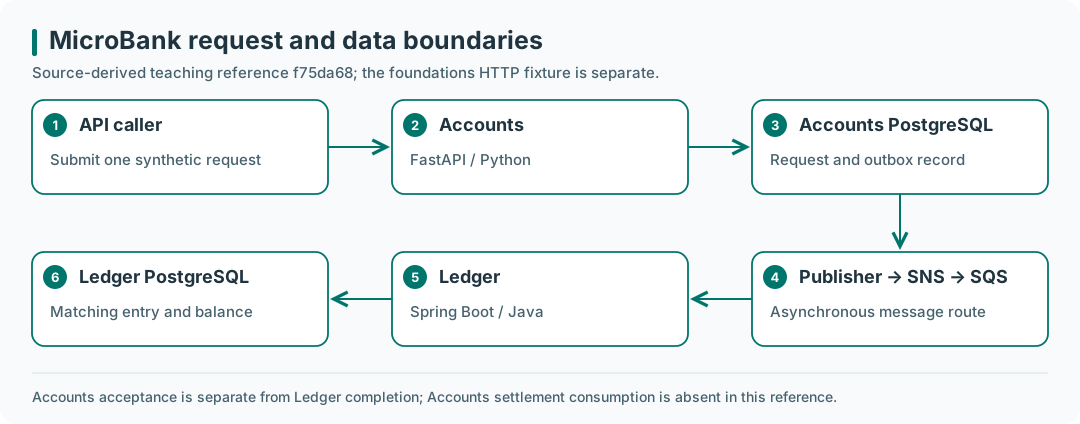
Open the diagram at full size.
Accounts uses FastAPI/Python; Ledger uses Spring Boot/Java; each has a PostgreSQL database. The optional React browser frontend is another component. In the pinned teaching reference, Ledger processing can complete while Accounts remains pending, because the Accounts settlement consumer is absent. A page load, an Accounts health response, and a matching Ledger entry answer different questions.
Create an inventory with component, source path, runtime, incoming/outgoing connection, storage, and verification. Inspect the reference through the linked guide or read-only source browsing. Add observed local values only after you actually run the corresponding profile. Do not invent database sizes, service accounts, ports, successful requests, or production readiness.
2. Separate the public URL from local runtime endpoints
Use https://microbank.learnwithsk.dev/ as the intended public project URL. The hostname is microbank.learnwithsk.dev; / is an HTTP path, not part of a DNS record. Public DNS and the HTTPS endpoint may be unavailable while the project is being prepared. A completed foundations record can include that observed failure.
From a terminal with the tools installed, make bounded, read-only checks:
dig +time=3 +tries=1 microbank.learnwithsk.dev A
dig +time=3 +tries=1 microbank.learnwithsk.dev AAAA
curl --connect-timeout 5 --max-time 15 --max-redirs 3 \
  --location --silent --show-error --output /dev/null \
  --write-out 'status=%{http_code} ip=%{remote_ip} final=%{url_effective}\n' \
  https://microbank.learnwithsk.dev/
printf 'curl exit status: %s\n' "$?"
Record time, resolver, query type, DNS status/answers/TTL, curl status, and final URL. If resolution fails, there is no HTTP response to report; curl's 000 output is not an HTTP status returned by a server. If a page responds, describe the content actually served. A public landing page or edge response does not establish a connection to Accounts or a working transaction.
Public URL, loopback address, container service name, and database endpoint belong to different contexts. Keep them separate in the drawing. DNS records or Cloudflare settings do not need to change for this lab. If the public URL is unavailable, use the local fixture below for the executable HTTP checks.
3. Prepare a new Linux evidence directory
Use Linux home storage for the permission and service exercises. Inspect ls -ld ~/microbank-foundations; if that name exists, select another unused name consistently instead of replacing it. For a new directory:
mkdir -p ~/microbank-foundations/public ~/microbank-foundations/notes
cd ~/microbank-foundations
printf '# MicroBank foundations readiness\n' > README.md
cat > public/index.html <<'EOF'
<!doctype html>
<html lang="en">
<meta charset="utf-8">
<meta name="viewport" content="width=device-width, initial-scale=1">
<title>MicroBank foundations evidence</title>
<h1>MicroBank foundations learning fixture</h1>
<p>Static evidence page. No bank API or transaction processing.</p>
<p>Project URL: https://microbank.learnwithsk.dev/</p>
</html>
EOF
Keep the following records under notes/, using results from completed module labs:
| Record | Include |
|---|---|
system-map.md | Selected source revision, component/dependency map, and untested application checks |
environment.md | Distribution, architecture, kernel, user identity, package/tool inventory |
access-storage.md | Fixture ownership/modes, target mount, space/inodes, tested access/recovery route |
network.md | Public DNS/URL observations and separate local fixture listener/request results |
runbook.md | Exact local start/stop/restart, expected page marker, failure checks, and cleanup |
These filenames describe work to complete, not pre-existing evidence. Only the public/ directory is served; notes and Git metadata stay outside it. This practice directory is separate from the application and infrastructure checkouts.
4. Start, diagnose, and recover the local fixture
In Linux terminal A, inspect ss -lnt and confirm that loopback port 8765 is unused. If occupied, choose another unused port consistently throughout the fixture and diagnostic. Do not stop an unrelated listener. Then:
cd ~/microbank-foundations
busybox httpd -f -p 127.0.0.1:8765 -h "$PWD/public"
In Linux terminal B, inspect ss -lnt, request http://127.0.0.1:8765/ with bounded curl options, and verify the expected MicroBank foundations learning fixture marker. Request /missing and compare the HTTP error with a connection failure after stopping terminal A using Ctrl-C. Restart the same command and repeat the original successful check. Record actual statuses and observations.
Keep both terminals in the same machine: their loopback address refers to that Linux network context. Browser access from the Mac is optional and follows the OrbStack networking documentation↗. Do not change the bind to all interfaces just to make a browser result appear.
For the service-management extension, first confirm the resolved BusyBox path is /usr/bin/busybox and the user manager works. Stop the manual server, check that ~/.config/systemd/user/learnwithsk-microbank-evidence.service is unused, and create a new complete user unit there:
[Unit]
Description=MicroBank foundations static evidence fixture

[Service]
Type=exec
ExecStart=/usr/bin/busybox httpd -f -p 127.0.0.1:8765 -h %h/microbank-foundations/public
Restart=on-failure
RestartSec=5
If the executable, directory, or port differs, adapt the unit to the values you inspected. Use systemctl --user daemon-reload, start only learnwithsk-microbank-evidence.service, and inspect its status/journal. Then request the expected page. Stop/start the named unit and repeat that request. Boot enablement is optional and depends on the user-session lifecycle. This unit supervises the static fixture, not MicroBank application services.
5. Add a bounded, read-only diagnostic
Save this as check-foundations.sh in the new project directory. It checks the local fixture at the chosen port; if you selected another port, change the URL here consistently. It does not call the public hostname or submit a transaction.
#!/usr/bin/env bash
if [[ $# -ne 1 ]]; then
  printf 'Usage: %s PROJECT_DIRECTORY\n' "$0" >&2
  exit 2
fi
study_project=$1
if [[ ! -d "$study_project" ]]; then
  printf 'Missing project directory\n' >&2
  exit 1
fi
for study_tool in ls df du ss curl; do
  if ! command -v "$study_tool" >/dev/null 2>&1; then
    printf 'Missing tool: %s\n' "$study_tool" >&2
    exit 1
  fi
done
for study_file in README.md public/index.html notes/system-map.md \
  notes/environment.md notes/access-storage.md notes/network.md notes/runbook.md; do
  if [[ ! -f "$study_project/$study_file" || ! -r "$study_project/$study_file" ]]; then
    printf 'Missing or unreadable evidence: %s\n' "$study_file" >&2
    exit 1
  fi
done
ls -ld -- "$study_project" "$study_project/public" || exit 1
df -h -- "$study_project" || exit 1
du -sh -- "$study_project" || exit 1
ss -lnt || exit 1
if ! study_page=$(curl --noproxy '*' --fail --silent --show-error \
  --connect-timeout 2 --max-time 3 http://127.0.0.1:8765/); then
  printf 'Local evidence-page request failed\n' >&2
  exit 1
fi
if [[ "$study_page" != *'MicroBank foundations learning fixture'* ]]; then
  printf 'Expected fixture marker is missing\n' >&2
  exit 1
fi
printf 'Local foundations fixture checks passed; MicroBank transaction untested.\n'
Run bash -n check-foundations.sh, then bash check-foundations.sh "$HOME/microbank-foundations" and capture its status immediately. Run ShellCheck if available. Test missing arguments (2), a missing directory (1), a stopped fixture (1), a response with a missing marker (1), and the complete expected fixture (0). Use only this disposable page for the marker change and restore it afterwards. Record a deliberate regression and its repair as taught in the shell lab.
A 0 result confirms the required local files were readable and the fixed local URL returned its expected marker at that moment. It does not parse the notes for correctness, establish the identity of the responding process, inspect Accounts/Ledger, or prove a deposit succeeded. Pair the diagnostic with the listener/process observations and review the notes yourself.
6. Review one change and one recovery
After confirming this is the new practice directory, use the taught local-author setup and initialize a Git repository here. Inspect and stage only the intended sanitized evidence, page, and script. Make a baseline commit, review a small runbook improvement on a practice branch, and integrate it locally.
For recovery practice, commit a clearly labelled wrong statement in the disposable runbook, inspect that commit, and reverse it using the earlier git revert sequence. Check the corrected text and rerun the fixture diagnostic. A Git revert restores source content through a new commit; it does not undo database or infrastructure changes.
Repository ownership for later real work is explicit: MicroBank↗ owns application code and tests; Ship Boring Lab↗ owns IaC, Ansible configuration/bootstrap, GitOps, and Backstage configuration. LearnWithSK owns curriculum. Adopt relevant configuration into the owning repository deliberately; this foundations lab neither migrates state nor deploys a platform.
Connect every module to the readiness record
| Module | Retained learning outcome and MicroBank evidence |
|---|---|
| Request journey | Search versus direct navigation, DNS/HTTPS/HTTP boundaries, observed or explicitly unavailable public URL |
| Virtualization | Actual Linux/kernel boundary, controlled patch, and tested fixture recovery copy |
| Cloud concepts | Local versus proposed hosting model and component responsibility map |
| Files and permissions | Traversal/read diagnosis, scoped repair, and same-user verification |
| Processes and logs | Failure timeline, exact lifecycle action, and separate HTTP result |
| Storage and packages | Actual mount, capacity/inodes, tool inventory, and distinct future database questions |
| Networking | Listener, successful page, missing path, stopped connection, and repeatable recovery |
| Access | Intended identity, SSH evidence, and limitations of the alternate access route |
| Shell | Read-only input/output contract, failure cases, deliberate regression, and repair |
| Git | Reviewed change, focused commits, and a recovery commit |
Checkpoint, cleanup, and next path
Show the system map, completed evidence records, local fixture page, diagnostic test results, reviewed Git change, and startup/recovery runbook. Include at least three short entries based on completed labs. State which items are observed, source-derived, proposed, or pending. Completion is self-reported; documentation review is not Linux execution verification.
Stop the manual server with Ctrl-C or stop the named user unit. If retiring the unit, remove only its course-owned file and reload user units. Retain the project evidence; clean up only the identified disposable fixtures. A personal blog or portfolio remains an optional place to publish sanitized learning entries.
Continue to Cloud Foundations to develop the operating design, then DevOps Foundations for the full local MicroBank implementation and transaction checks.
Sources
Pinned MicroBank source↗; versioned implementation guide; BusyBox HTTP server↗; curl↗; systemd service semantics↗; Git basics↗.
Prove what you learned
Inspect the result
Retain status/diff evidence, the relevant commit identity and the recovery result.
Explain it in your own words
Explain why your observation supports the stated outcome, and name one thing it does not prove.
Try a small variation
Make a second uncommitted edit after staging and predict which version a commit would record.
Your evidence should show
- Record the context/revision or label the work as a paper or prepared fixture.
- Compare the prediction with the actual result from “Start with the system you will keep improving”.
- Retain status/diff evidence, the relevant commit identity and the recovery result.
- Explain the transfer challenge and retain the same verification question.
Hint
Compare working tree, index and committed snapshot.
Answer guide: compare after predicting
No. A commit records staged content. Inspect the diff at the correct boundary before committing or recovering.
Compare this with your actual observation. A paper answer is useful reasoning practice; record execution separately.
Recall why a runbook change needs the same behaviour check after recovery. Revisit the previous lesson.
Save the prediction, result and explanation ↓Your notes and evidence
Record observations, questions, or links to your work. Keep credentials out of your notes.
Back up or restore this path
Progress and notes stay in this browser. A backup contains only this learning path.